



What Is GEO? Generative Engine Optimization Explained
GEO is the practice of optimizing website content so AI-powered search systems can discover, understand, evaluate, and potentially reference it in generated answers. GEO improves AI search visibility by making information clear, relevant, well-structured, entity-focused, and supported by trustworthy sources.
GEO does not replace traditional SEO. SEO helps search engines discover, understand, and rank webpages, while GEO focuses on improving how content can be understood and potentially referenced in generative search experiences.
If you want to evaluate your website’s readiness for AI search, you can run a free AI SEO & GEO audit tool.
Run a free AI SEO & GEO audit tool
Why Is GEO Important for AI Search?
Search used to end with a list of ten blue links. You’d click one, read it, and (maybe) come back for the next. That model assumed a human was doing the reading and deciding which link was worth their time.
This shift has created a new form of generative search optimization focused on helping brands appear in AI-generated responses. When someone asks ChatGPT, Gemini, or Google’s AI Overview a question, the AI reads several sources, synthesizes an answer, and shows it directly — often with no click required at all. The AI, not the user, is now the one deciding which sources are trustworthy enough to summarize or quote.
AI Search Optimization Services for Better Search Visibility
GEO is the discipline of making sure your content is one of the sources that gets picked. A strong GEO strategy makes important information easier for generative search systems to understand, verify, and reference.
This isn’t a hypothetical shift. ChatGPT has roughly 900 million weekly users and Gemini has about 900 million monthly users, and the ground is still moving under both — ChatGPT’s share of generative AI traffic fell from 86.7% to 64.5% in the twelve months to January 2026, while Gemini grew from 5.7% to 21.5% over the same period. More importantly for generative engine optimization specifically: research from GEO firm Brandlight found the overlap between top Google search results and the sources AI systems actually cite has dropped from roughly 70% to below 20% — ranking well in traditional search no longer guarantees you’ll be the source an AI cites. See Search Engine Land’s GEO guide for how to close that gap.
How Does GEO Work?
GEO works by making website content easier for AI search engines and other AI-powered search systems to discover, understand, evaluate, and potentially reference when generating answers.
The process can involve several stages, from finding relevant information to selecting useful sources and incorporating information into an AI-generated response.
AI Systems Discover Relevant Content
AI-powered search experiences can retrieve information from webpages and other online sources when responding to a user's query. Your content needs to be technically accessible and available for discovery before it can potentially be considered as a source.
The System Understands the Content
The system analyzes the information it retrieves to determine what the page is about and which parts may be relevant to the user's question. Clear headings, concise explanations, descriptive entities, structured information, and well-organized content can make important information easier to interpret.
Relevant Information Is Selected
AI systems may compare information from multiple sources and select content that is relevant to the query. Relevance, context, source quality, freshness, and other signals can influence which information is useful for a particular answer.
Useful Information May Be Referenced
When an AI-generated answer uses information from a source, the system may cite, link to, mention, or otherwise reference that source. A clear, factual, self-contained passage is easier to understand and potentially reuse than information buried inside a long or ambiguous section.
The Information Is Used in the Generated Answer
The selected information can then contribute to an AI-generated response. GEO therefore focuses on making important information understandable and useful at the point where an AI system retrieves and evaluates it.
What Are the Most Important GEO Signals?
GEO signals are factors that can help AI-powered search systems understand, evaluate, and potentially reference website content. There is no single GEO algorithm, but these practical factors are important
- Relevance: Directly answer the user’s question.
- Clarity: State important information clearly and concisely.
- Structure: Use descriptive headings, short paragraphs, lists, and tables.
- Entities: Clearly identify your brand, organization, products, people, and services.
- Trust: Use accurate information and credible sources.
- Technical accessibility: Make content crawlable, indexable, and accessible.
- Structured data: Use relevant Schema.org markup that matches visible content.
- Freshness: Keep important information accurate and updated.
- Original information: Add unique data, examples, research, or useful insights.
What Are the Benefits of GEO?
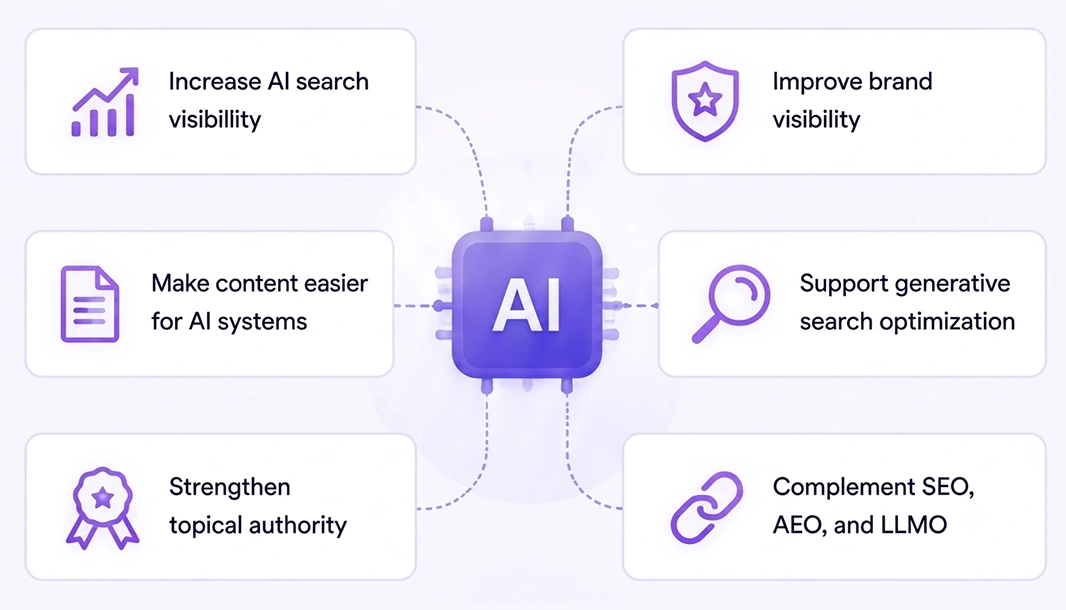
GEO can improve AI search visibility by making your website content easier for generative search systems to discover, understand, and potentially reference. GEO for AI search focuses on clear, relevant, structured, and trustworthy content.
- Increase AI search visibility and opportunities for AI citations.
- Improve brand visibility in AI-generated answers.
- Make content easier for AI systems to understand and reference.
- Support generative search optimization and conversational queries.
- Strengthen topical authority through clear, useful content.
- Complement SEO, AEO, and LLMO as search behavior evolves.
What Is a GEO Audit?
A GEO audit evaluates how well a website is prepared for AI-powered search and generative search. It checks content clarity, AI search visibility, entity information, structured data, technical accessibility, and other factors that can affect how easily AI systems understand and potentially reference a website. A GEO audit can identify opportunities to improve AI search visibility and AI search citations.
A GEO audit can help identify GEO optimization opportunities, AI search visibility issues, and content improvements that complement traditional SEO.
What Is a GEO Audit Tool?

A GEO audit tool is software that analyzes a website for factors related to AI search visibility and Generative Engine Optimization. It can identify issues with content structure, technical SEO, structured data, entities, accessibility, and other areas that may affect how AI-powered search systems understand a website. A GEO audit tool helps website owners find GEO optimization opportunities, improve AI search readiness, and monitor areas that support visibility in generative search.

What Is a GEO Score?

A GEO score is an assessment of how well a website’s content and technical foundation support visibility in AI-powered and generative search. A GEO score can consider factors such as content clarity, structured data, entity information, technical accessibility, and AI search readiness. A GEO score helps identify GEO optimization opportunities and areas that may need improvement for better AI search visibility.

How Do You Measure GEO Performance?
GEO performance can be measured by tracking visibility, mentions, and AI search citations across AI-powered search experiences. Useful measurements include AI citations, brand mentions, source references, AI search visibility, referral traffic, and changes in relevant search queries.

AI citations
how often your content is referenced.

Brand mentions
how often your brand appears in AI answers.

AI search visibility
how frequently your website appears across relevant AI queries.

Referral traffic
visits generated from AI platforms.

Citation quality
whether important pages and content are being referenced.

GEO measurement should be viewed alongside traditional SEO metrics such as rankings, impressions, clicks, and organic traffic.
Who Needs GEO?
GEO can benefit businesses, agencies, publishers, ecommerce websites, SaaS companies, and website owners that want greater visibility in AI-powered and generative search. It is especially useful for brands that want their content, products, services, or expertise to be understood and potentially referenced in AI-generated answers.
GEO can support AI search visibility, generative search optimization, brand visibility, and traditional SEO efforts.
How Is GEO Different From SEO?
| Traditional SEO | GEO Future | |
|---|---|---|
| Optimizes For | Ranking position in search results | Being extracted and cited inside AI-generated answers |
| Success Looks Like | More organic clicks | AI citations, mentions, AI visibility, and brand visibility—even without a click |
| Core Levers | Keywords, backlinks, technical SEO, crawlability | Entities, structured data, direct answers, semantic clarity, trusted sources |
| Content Style | Optimized to rank first, then persuade readers | Optimized to be quotable, factual, and understandable by AI models |
| Measurement | Rankings, impressions, CTR, organic traffic | AI citations, LLM visibility, brand mentions across AI platforms |
Traditional SEO is still the foundation. Without crawlability, clean site architecture, and quality content, AI systems have nothing reliable to understand or cite. GEO doesn't replace SEO—it builds on it by making your content easier for AI to interpret, trust, and reference.
How Do Generative Engines Decide What to Cite?
These signals can be considered important GEO ranking factors because they help AI systems identify useful, reliable, and contextually relevant information.

Unambiguous
a claim stated plainly, not buried in a wall of marketing copy

Self-contained
the answer doesn't require reading three other paragraphs first to make sense

Well-structured
headers, lists, and short paragraphs are easier for a model to parse and extract cleanly than dense blocks of text

Backed by clear entities
the AI can tell who is saying this (a named organization, a defined product, a real author) rather than an anonymous or ambiguous source

Consistent across the web
if the same facts about your brand appear consistently across your site, your schema markup, and third-party mentions, models trust them more

How Do You Optimize Content for GEO?
These GEO best practices provide a practical checklist, roughly in priority order
Here is best GEO Checklist:

Answer the core question in the first 2-3 sentences of any page or section.
Don't make the reader (or the AI) scroll to find your actual answer.

Define your key terms explicitly.
If you use a term like "GEO," define it the first time it appears rather than assuming prior knowledge.

Use structured headers (H2/H3) that mirror real questions people ask.
What is GEO?" as a literal H2 is more citation-friendly than a vague header like "Overview.

Add FAQ sections with FAQPage schema.
This gives AI systems a pre-packaged question/answer pair that's easy to lift directly.

Add Organization and Article schema site-wide.
This helps AI systems correctly identify who you are and when content was published or updated.

Keep paragraphs short.
Three lines or fewer per paragraph is easier for a model to chunk and extract than a dense 200-word block.

Use lists and tables for comparative or step-based information
the way this page does — models extract structured data more reliably than prose.

Keep content current.
Update `dateModified` and revisit key pages periodically; freshness signals matter more in fast-moving topics like AI search itself.

Build genuine topical depth
not just keyword coverage. A handful of comprehensive, well-linked pages on a topic outperform a dozen thin ones.

When building topical depth, the AI Question Gap Generator can help identify relevant questions and subtopics that your content may not yet cover. Use these findings to strengthen question coverage without adding unnecessary or repetitive content.
What Is the Difference Between SEO, GEO, AEO, and LLMO?

SEO (SearchEngine Optimization)
is the practice of improving a website's visibility and rankings in traditional search engine results.

AEO (Answer Engine Optimization)
is the practice of optimizing content to be pulled as a direct, standalone answer to a specific question.

LLMO (Large Language Model Optimization)
the broader practice of making your brand and content easy for LLMs generally (ChatGPT, Claude, Gemini) to understand, trust, and reference — even outside a live search context
What Are the Most Common GEO Mistakes?
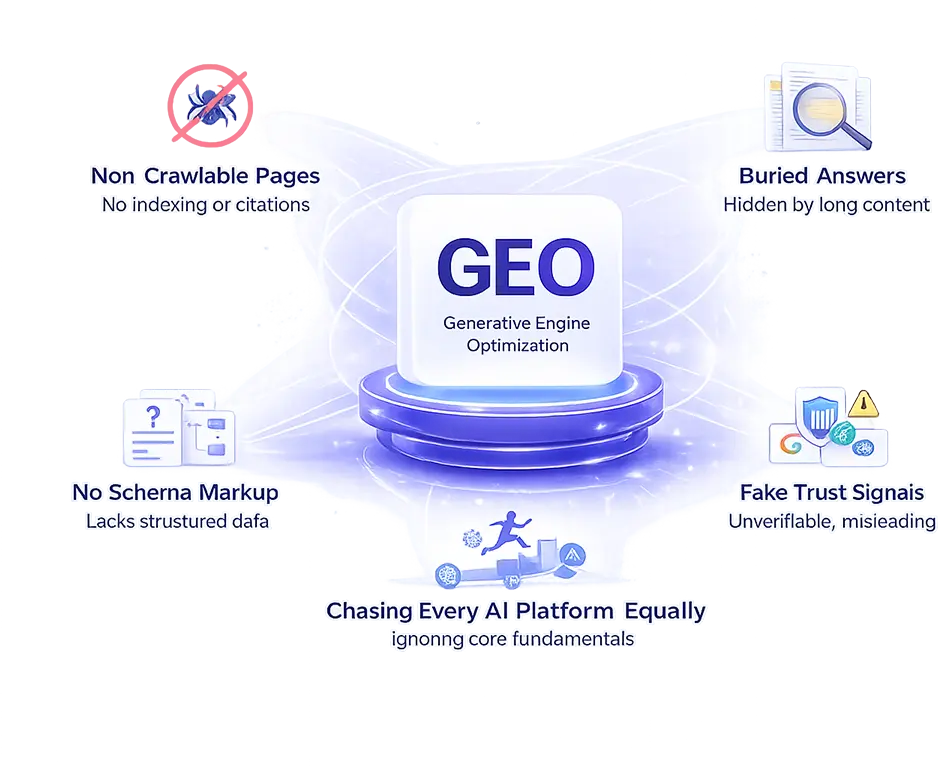
- Treating GEO as a replacement for SEO instead of an addition to it: A page that isn’t crawlable or indexed won’t get cited by anything.
- Burying the answer: If your best content is one clear paragraph hidden inside 2,000 words of preamble, it’s not extractable.
- Fabricated trust signals: Fake stats, fake testimonials, or misused brand logos actively hurt GEO — AI systems weight source credibility, and inconsistent or unverifiable claims are a credibility red flag, not a shortcut.
- No schema markup: Skipping Article, Organization, and FAQPage schema leaves AI systems guessing at context you could have stated explicitly.
- Chasing every AI platform equally: Different engines weight signals differently; start with the fundamentals (structure, clarity, schema) that help across all of them rather than platform-specific tricks.
- Effective GEO optimization depends on clear information, trustworthy sources, consistent entities, and technically accessible content.
How Do You Check Where You Stand?
Frequently Asked Questions
What is Generative Engine Optimization (GEO)?
What GEO stand for?
GEO stands for Generative Engine Optimization. It focuses on improving content visibility across AI-powered and generative search experiences.
How does GEO work?
GEO works by improving the clarity, structure, authority, entity information, and technical accessibility of content so generative AI systems can more easily understand and reference it when producing answers.
How do you optimize content for GEO?
Optimize content for GEO by providing direct answers, using clear headings and structured content, defining entities, supporting claims with trustworthy sources, and maintaining strong technical SEO.
Why is GEO important for AI search?
GEO is important because AI-powered search can use information from multiple sources to generate answers. Optimized content may have more opportunities to be understood and potentially referenced in these answers.
What is the difference between GEO and SEO?
SEO focuses primarily on improving visibility and rankings in traditional search results, while GEO focuses on making content easier for AI-powered search systems to understand and potentially reference.
What is a GEO audit?
A GEO audit evaluates how well a website is prepared for AI-powered and generative search. It can identify content, technical, structured data, entity, and AI search visibility opportunities.
What is a GEO audit tool?
A GEO audit tool analyzes a website for factors related to Generative Engine Optimization and AI search visibility. It can help identify areas that may need improvement.
How do I know if my site is optimized for GEO?
How do you measure GEO performance?
GEO performance can be measured using AI citations, brand mentions, source references, AI search visibility, referral traffic, and relevant search visibility. These metrics can be considered alongside traditional SEO metrics.
How long does it take to see GEO results?