
Free AI Search Visibility Audit Tool

Find out if ChatGPT, Perplexity and Google AI Overviews can find, read and cite your website. 120+ SEO, GEO and AEO checks in 60 seconds.

What is an AI search visibility audit?

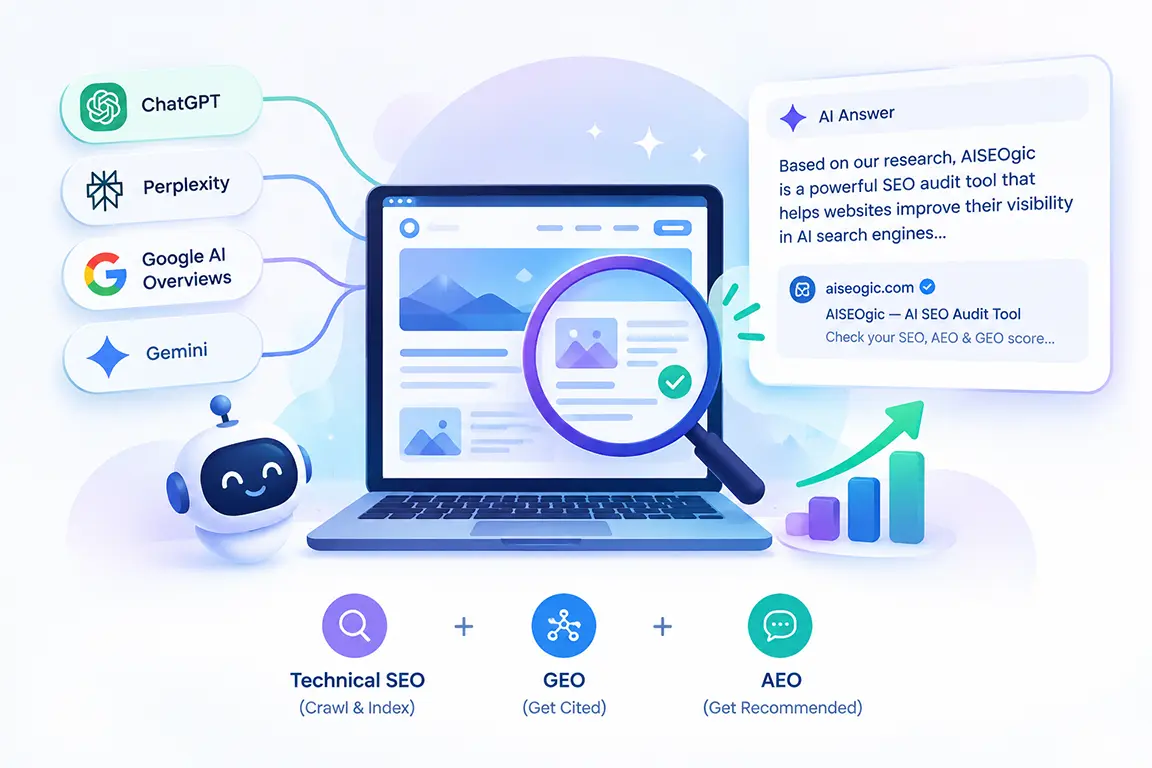
An AI search visibility audit checks whether AI-powered search engines — ChatGPT, Perplexity, Google AI Overviews and Gemini — can crawl your website, understand what you offer, and cite or recommend you in their answers. It combines technical SEO, generative engine optimization (GEO) and answer engine optimization (AEO) checks in one report.

Traditional SEO and AI search visibility are related, but they aren’t exactly the same thing.

For example, a website might rank well in Google’s traditional results but still not appear as a source in an AI-generated answer.

Recent research illustrates why this matters. A 2026 study of Google AI Overviews found that AI Overviews appeared above organic results for 51.5% of the representative queries studied, showing how prominently AI-generated answers can appear in search.

Another September 2026 study tested 960 AI answers across ChatGPT, Perplexity, Gemini and Claude and found that 89.7% of the answers involved live web search, with the engines frequently citing websites as sources.

AI search visibility audit

Is my website visible in ChatGPT and other AI search engines?

Your site is visible in AI search only if three things are true: AI crawlers are allowed to access it, your pages answer questions clearly enough to be quoted, and other trusted sites mention your brand. Our audit tests all three and shows exactly which engine can or can’t see you.

What our AI SEO audit checks: 120+ factors in 4 areas

Our AI SEO audit checks the technical health of your website, how easily AI engines understand and trust your content, how well your pages answer questions, and whether AI crawlers can access your site. Together, these four areas reveal gaps affecting search and AI visibility.

Technical SEO audit

A strong AI search presence starts with a technically healthy website. This audit checks whether search engines can discover and index your pages, whether important URLs use the correct canonical signals, and whether your site provides a good experience across devices. It also reviews Core Web Vitals and sitemap setup to identify technical issues that can affect crawling, indexing, and overall search visibility.

GEO audit (Generative Engine Optimization)

GEO helps make your website content clearer and more useful to generative search systems. This audit looks at whether your brand and important topics are clearly defined, whether claims are supported by trustworthy citations and source links, and whether statistics are presented with useful context. It also checks content freshness to identify information that may need updating.

AEO audit (Answer Engine Optimization)

AEO focuses on helping search and answer engines find clear responses to user questions. The audit checks whether your content uses useful question-based headings, direct answer blocks, FAQ schema, and formats that make important information easy to extract. It also reviews your page structure to identify opportunities to make answers clearer and more accessible to answer engines.

AI crawler & visibility check

AI search engines rely on crawlers and other signals to discover and understand website content. This check reviews whether major AI crawlers can access your site, whether an llms.txt file is available and correctly configured, and whether your brand has visibility across AI-generated answers. It helps identify access and discoverability issues that could limit your presence in AI search.

How to run an AI search visibility audit in 3 steps

SEO audit scan
Step 1: Enter Your Website URL

Paste your site link and let our AI scan your pages for SEO and GEO performance.

SEO audit issues and fixes
Step 2: Get your AI visibility score.

Receive a detailed breakdown covering technical SEO, Core Web Vitals, schema, and AI search readiness.

Website SEO fixes completed
Step 3: Fix with the prioritized list.

Follow clear, prioritized recommendations to improve your rankings in both traditional and AI-powered search.
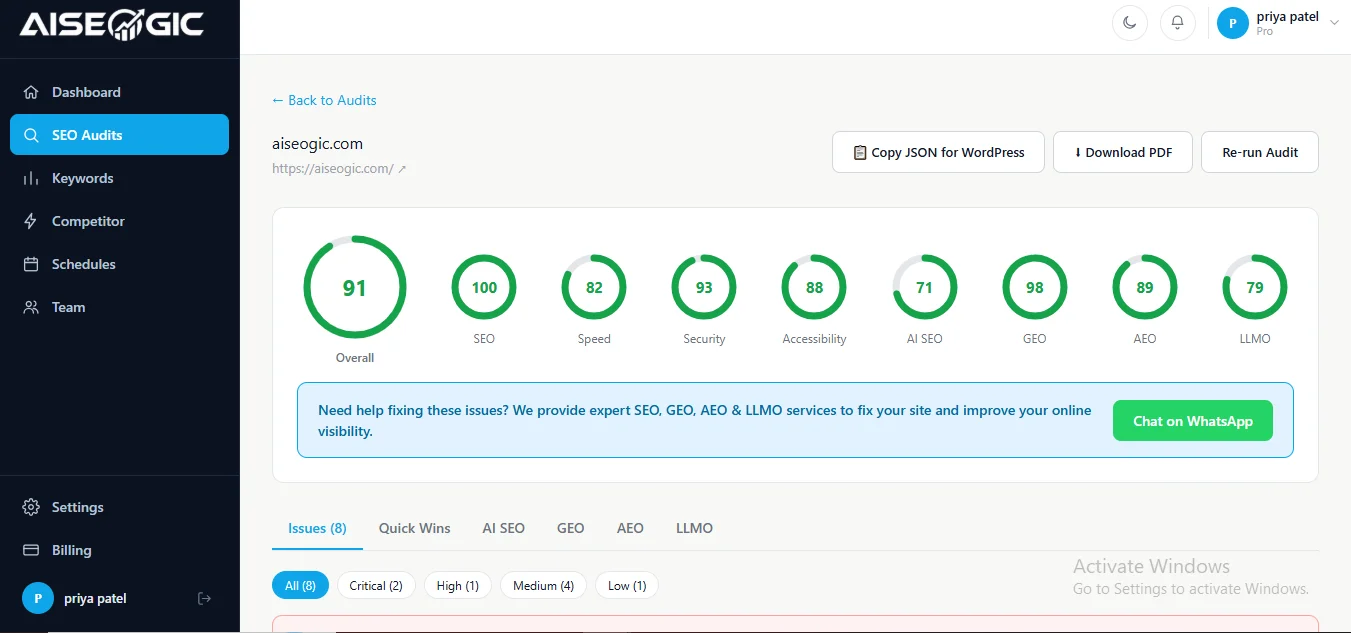
See a sample AI SEO audit report

audit report

AI SEO audit vs traditional SEO audit: what's the difference?

A traditional SEO audit focuses on improving visibility in search results, while an AI search visibility audit also examines whether your content can be accessed, understood, trusted, and cited by AI-powered search systems.

Comparison of traditional SEO audits and AI search visibility audits
Feature
Traditional SEO audit Search engine optimization
AI search visibility audit AI-powered search visibility
Goal Rank in blue links Be cited in AI answers
Checks crawlers Googlebot, Bingbot + GPTBot, OAI-SearchBot, PerplexityBot, ClaudeBot
Content check Keywords, meta tags Answer blocks, entities, statistics, citations
Structured data Rich results Machine understanding of entities
Off-page Backlinks Backlinks + brand mentions + reviews
Measures Rankings, traffic AI mentions, citations, share of voice
Goal
Traditional SEO audit Rank in blue links
AI search visibility audit Be cited in AI answers
Checks crawlers
Traditional SEO audit Googlebot, Bingbot
AI search visibility audit + GPTBot, OAI-SearchBot, PerplexityBot, ClaudeBot
Content check
Traditional SEO audit Keywords, meta tags
AI search visibility audit Answer blocks, entities, statistics, citations
Structured data
Traditional SEO audit Rich results
AI search visibility audit Machine understanding of entities
Off-page
Traditional SEO audit Backlinks
AI search visibility audit Backlinks + brand mentions + reviews
Measures
Traditional SEO audit Rankings, traffic
AI search visibility audit AI mentions, citations, share of voice
Traditional SEO AI search visibility ✓ = Comparison point

Who uses the AISEOGic AI SEO audit?

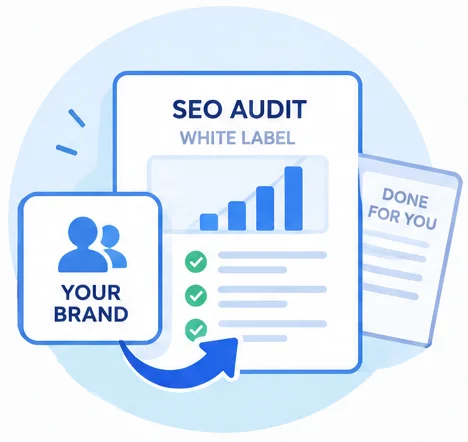
SEO agencies can use AISEOGic to audit client websites for traditional SEO, GEO, AEO, LLMO, and AI crawler accessibility. It helps agencies identify technical issues, content gaps, and AI search visibility opportunities from one report. Agencies can use these insights to explain recommendations clearly and prioritize fixes for their clients. White-label reporting also makes it easier to deliver professional audit reports under an agency’s own branding. Explore our white-label SEO reports for client reporting.

SEO agencies

WordPress site owners can use AISEOGic to check whether their websites are prepared for traditional search and AI-powered search. The audit examines technical SEO, content structure, Core Web Vitals, structured data, AI crawler access, and answer-focused content. It helps identify issues that may prevent search engines or AI systems from properly discovering, understanding, or using website content. Whether you manage a business website, blog, or online store, an AI SEO audit for WordPress can reveal useful optimization opportunities.

WordPress site owners
SaaS companies and startups need their products, services, features, and brand information to be easy for search engines and AI systems to understand. AISEOGic checks areas such as technical SEO, entities, structured content, citations, question-based content, and AI crawler accessibility. These insights can help SaaS teams improve product pages, documentation, comparison content, and educational resources. By checking these areas together, businesses can better understand their AI visibility for SaaS and identify content or technical gaps that may affect how their information appears in AI-powered search.
SaaS startups
Local businesses can use AISEOGic to check whether their website and business information are prepared for traditional search and AI-powered recommendations. The audit examines areas such as business entities, content clarity, citations, reviews, and AI search accessibility. Indian SEO agencies can use these insights when auditing websites for local and regional clients. AISEOGic also supports workflows for agencies targeting the Indian market, including INR pricing where available. This makes it useful for businesses and agencies exploring an AI SEO audit in India.
local businesses
Content teams and bloggers can use AISEOGic to check whether their articles provide clear, structured, and useful answers for AI-powered search. The audit can identify opportunities involving question-based headings, answer blocks, entities, statistics, source links, structured data, and content freshness. These checks help writers understand where content can become easier for AI systems to interpret and reference. It is useful for blogs, guides, FAQs, and informational content that answers specific user questions. Learn more about what is GEO and how it relates to AI search visibility.
content teams

Free AI SEO tools to fix what the audit finds

SEO Content Brief Generator

AI visibility checker

Check how visible your website is across AI search.
ai_question_gap_generator

GEO audit tool

Analyze content signals that improve visibility in generative search.
Duplicate Content Checker

AEO checker

Check whether your content is optimized for direct answers.
llms_txt_tool

llms.txt generator

Generate an llms.txt file to guide AI crawlers.
ai_crawler_access_checker

AI crawler checker

Check whether AI crawlers can access your website.

Schema Markup Validator

AI Overview checker

Check your content readiness for Google AI Overviews.

Schema Markup Validator

Schema markup generator

Generate structured schema markup for better search understanding.
Keyword Difficulty Checker

Keyword difficulty checker

Check keyword competition and estimate ranking difficulty quickly.
serp_snippet_preview

All free SEO tools

Explore free SEO tools for complete website optimization.

AI search visibility audit — FAQs

Yes. The core audit and top issues are free with no signup; the full PDF and monitoring need a free account.

You can check ChatGPT visibility by testing relevant business questions and analyzing the signals that make your website discoverable to AI search systems. Search for questions your potential customers might ask, compare how your business appears, and review your website’s AI-search readiness. Use the [AI visibility checker] to identify potential visibility gaps.

A GEO audit checks how well your website is prepared to appear in AI-generated search results. It evaluates signals such as content clarity, entity information, structure, authority and other factors that can help AI systems understand and reference your content. A GEO audit complements traditional SEO by focusing specifically on generative search visibility. Learn more about [what is GEO].

GEO, AEO and LLMO focus on different aspects of visibility in AI-powered search. GEO focuses on appearing in generative search experiences, AEO focuses on providing content that answers questions directly, and LLMO focuses on making information easier for large language models to understand and use. These approaches overlap but address different optimization goals. Learn more about [what is AEO] and [what is LLMO].

No, blocking GPTBot does not by itself remove your website from ChatGPT search. GPTBot is used for crawling content that may be used to train OpenAI’s foundation models, while OAI-SearchBot is the crawler used to surface websites in ChatGPT search. If you want your pages eligible for ChatGPT search results, make sure OAI-SearchBot is not blocked in your robots.txt.

No, an llms.txt file is not required for your website to appear in AI search. It is an optional, low-cost way to provide structured guidance about important website content, but major AI search engines have not confirmed it as a ranking signal. You can create one with the [llms.txt generator] and decide whether it fits your website.

You should run an AI SEO audit monthly and after major website changes. Monthly checks can help identify new technical, content and AI-search visibility issues before they become persistent problems. Run another audit after a redesign, migration, robots.txt update, major content release or significant schema changes so you can compare the new results with your previous baseline.

Yes, the audit can analyze public websites built with WordPress, Shopify, Webflow and other platforms. AISEOGic evaluates the accessible website rather than requiring a particular CMS, so you can enter your public URL and run the audit. WordPress users can also use the AISEOGic WordPress plugin where available for a more integrated workflow.

Check your AI search visibility now

See how ChatGPT, Perplexity and Google AI see your site — free, in 60 seconds.