
Want to know if your website is optimized for search engines and AI-powered search?
Use this AI SEO audit checklist to check your website’s technical SEO, on-page SEO, content, structured data, performance, GEO, AEO, LLMO, and AI search readiness.
A complete AI SEO audit should help you understand three things:
What is wrong → Why it matters → What you should fix
Use the checklist below to audit your website manually, or run a free AISEOgic audit to automatically identify SEO and AI search optimization opportunities.
What Is an AI SEO Audit?
An AI SEO audit is a complete analysis of a website’s SEO health and readiness for AI-powered search.
Traditional SEO focuses on helping search engines crawl, understand, and rank your website.
AI SEO goes further by looking at how clearly your website communicates information to AI-powered search and answer systems.
A complete AI SEO audit can evaluate:
- Technical SEO
- Crawlability and indexability
- On-page SEO
- Content quality
- Search intent
- Internal linking
- Structured data
- Website performance
- Core Web Vitals
- Mobile usability
- Accessibility
- Entity and brand information
- Answer Engine Optimization (AEO)
- Generative Engine Optimization (GEO)
- Large Language Model Optimization (LLMO)
- AI search visibility
The goal is not simply to get a higher SEO score. The goal is to identify the problems and opportunities that can improve your website’s visibility.
1. Technical SEO Checklist
Technical SEO is the foundation of your website.
Before optimizing content, make sure search engines and AI systems can access, crawl, understand, and index your important pages.
Crawlability
- Important pages can be crawled.
- Robots.txt is available and correctly configured.
- Important pages are not accidentally blocked.
- Search-engine crawlers can access important resources.
- There are no unnecessary crawl restrictions.
- Important pages can be discovered through internal links.
Indexability
- Important pages are indexable.
- No important pages have an accidental
noindextag. - Canonical URLs are correctly configured.
- Duplicate pages are identified.
- HTTP and HTTPS versions are handled correctly.
- WWW and non-WWW versions are handled correctly.
- Redirects point to the correct destination.
XML Sitemap
- XML sitemap exists.
- XML sitemap is accessible.
- Important URLs are included.
- Sitemap URLs return successful responses.
- Sitemap does not contain unnecessary redirects.
- Sitemap does not contain broken URLs.
- Sitemap contains the preferred/canonical URLs.
HTTPS & Security
- Website uses HTTPS.
- HTTP redirects to HTTPS.
- SSL certificate is valid.
- No mixed-content issues exist.
- Security-related technical issues are reviewed.
URL Structure
- URLs are descriptive and readable.
- URLs follow a consistent structure.
- URLs do not contain unnecessary parameters.
- Duplicate URL versions are controlled.
- Redirected URLs are reviewed.
2. On-Page SEO Checklist
Every important page should clearly communicate its main topic.
Title Tag
- Every important page has a unique title.
- The title accurately describes the page.
- The primary topic is included naturally.
- Titles are not unnecessarily keyword-stuffed.
- Important pages do not have duplicate titles.
Meta Description
- Important pages have meta descriptions.
- Descriptions accurately describe the page.
- Descriptions communicate the page’s value.
- Primary keywords are used naturally.
- Descriptions encourage relevant clicks.
Headings
- Every important page has a clear H1.
- H1 describes the primary topic.
- H2 headings organize major sections.
- H3 headings organize supporting topics.
- Heading hierarchy is logical.
- Headings answer relevant user questions where appropriate.
Images
- Important images have descriptive filenames.
- Images have appropriate alt text.
- Large images are optimized.
- Modern image formats are used where appropriate.
- Images have appropriate dimensions.
- Decorative images are handled correctly.
3. Content SEO Checklist
Good SEO requires more than keywords.
Your content should satisfy the user’s search intent and provide useful information that is clear, accurate, and easy to understand.
Search Intent
- Primary search intent is clearly identified.
- Page directly answers the user’s query.
- Important related questions are answered.
- Content provides the information users actually need.
- The main answer is easy to find.
- Content does not include unnecessary information just to increase word count.
Content Quality
- Content provides original value.
- Information is accurate.
- Important claims are supported where appropriate.
- Content demonstrates relevant expertise.
- Content is easy to understand.
- Content is updated when information changes.
- Content avoids unnecessary repetition.
Topical Coverage
- Primary topic is clearly defined.
- Important subtopics are covered.
- Related concepts are explained.
- Relevant entities are included naturally.
- Important questions are answered.
- Content gaps have been identified.
4. Internal Linking Checklist
Internal links help users and search engines discover related content.
- Important pages have internal links.
- Important pages are not orphan pages.
- Related content links to related content.
- Anchor text describes the destination.
- Important commercial pages receive relevant internal links.
- Blog posts link to relevant product and service pages.
- Important pages are not buried too deeply.
- Broken internal links are fixed.
AISEOgic Internal Linking Opportunity
For AISEOgic, connect your educational content and tools together.
For example:
AI SEO → AI SEO Audit → AI SEO Audit Checklist → GEO → AEO → LLMO → SEO Tools → Free AI Audit
Your checklist page should also link naturally to your existing tools such as:
- Schema Validator
- FAQ Schema Generator
- Canonical Checker
- XML Sitemap Checker
- Meta Tag Analyzer
- Broken Link Checker
These tools are already part of your homepage offering.
5. Structured Data & Schema Checklist
Structured data helps search engines understand the information and entities represented on your website.
- Appropriate structured data is implemented.
- Organization schema is accurate where applicable.
- WebSite schema is accurate where applicable.
- WebPage schema is accurate where applicable.
- Breadcrumb schema is implemented where appropriate.
- Article schema is used for eligible articles.
- FAQ structured data is used appropriately.
- Structured data matches visible page content.
- Schema does not contain critical errors.
- Organization and business information is consistent.
Need to check your schema? Use the AISEOgic Schema Validator.
6. Core Web Vitals & Performance Checklist
Website performance affects user experience and is an important part of technical SEO.
- Check Largest Contentful Paint (LCP).
- Check Interaction to Next Paint (INP).
- Check Cumulative Layout Shift (CLS).
- Test mobile performance.
- Test desktop performance.
- Optimize large images.
- Reduce unnecessary JavaScript.
- Reduce render-blocking resources.
- Optimize CSS.
- Improve server response time.
- Review third-party scripts.
- Use caching appropriately.
AISEOgic already includes performance insights and checks for speed and Core Web Vitals in its audit positioning.
7. Mobile SEO Checklist
- Website works correctly on mobile devices.
- Mobile content is accessible.
- Text is readable.
- Buttons are easy to tap.
- Navigation works correctly.
- Important content is not hidden unnecessarily.
- Images display correctly.
- Mobile page speed is acceptable.
8. Accessibility Checklist
A website should be accessible to as many users as possible.
- Images have appropriate alternative text.
- Heading hierarchy is logical.
- Links have meaningful text.
- Forms have appropriate labels.
- Keyboard navigation works.
- Text has sufficient contrast.
- Interactive elements have understandable names.
- Important content is accessible to assistive technologies.
homepage already identifies accessibility as one of the areas that can affect website reach and usability, so this section fits naturally with your product positioning.
9. GEO Checklist — Generative Engine Optimization
Generative Engine Optimization focuses on improving how your website can be understood and potentially referenced in AI-powered search experiences.
[Understand how Generative Engine Optimization works]
Content Structure
- Important information is clearly stated.
- Pages use descriptive headings.
- Complex topics are divided into logical sections.
- Definitions are clear.
- Questions have direct answers.
- Important facts are easy to find.
- Content avoids unnecessary ambiguity.
AI Discoverability
- Important pages are crawlable.
- Important information is publicly accessible.
- Brand information is clearly presented.
- Organization information is consistent.
- Author information is available where relevant.
- Important claims have supporting evidence where appropriate.
- Content demonstrates expertise and credibility.
AI Citation Readiness
- Content provides specific information.
- Important claims can be understood without additional context.
- Definitions are clearly written.
- Data is presented clearly.
- Common questions are answered directly.
- Content provides useful information that AI systems can understand and potentially reference.
10. AEO Checklist — Answer Engine Optimization
Answer Engine Optimization focuses on making content easier for answer engines to understand and use when responding to questions.
[Explore our complete guide to AEO]
- Identify important questions your audience asks.
- Create sections that answer those questions.
- Provide a direct answer before detailed explanation.
- Use descriptive question-based headings where appropriate.
- Use lists for processes and steps.
- Use tables for useful comparisons.
- Define technical terms clearly.
- Keep answers accurate and updated.
- Avoid vague or unnecessarily complicated answers.
A useful content structure is:
Question → Direct Answer → Explanation → Example → Next Step
11. LLMO Checklist — Large Language Model Optimization
LLMO focuses on making website information easier for AI systems and large language models to understand and interpret.
- Brand name is consistent across your website.
- Company information is clearly explained.
- Products and services are clearly defined.
- Important entities are clearly identified.
- About information is easy to understand.
- Author information is available where relevant.
- Important terminology is used consistently.
- Related concepts are connected clearly.
- Supporting pages reinforce important topics.
- Organization information is consistent across the website.
AISEOgic specifically includes LLMO as part of its AI-search readiness positioning.
12. Entity & Brand SEO Checklist
Search engines and AI systems need to understand who you are, what your business does, and what entities are connected to your brand.
- Brand name is consistent.
- Company description is clear.
- Organization information is accurate.
- Relevant organization schema is implemented.
- Products are clearly described.
- Services are clearly described.
- Important people are identified where appropriate.
- External business profiles are consistent.
- Business information does not conflict across sources.
- Relevant knowledge-base/entity information is reviewed.
AISEOgic already positions Wikidata / Knowledge Graph checks as part of its AI-search capabilities, so this is an excellent differentiating section for your checklist.
13. E-E-A-T & Trust Checklist
Your website should make it easy for users and search systems to understand who is behind the content.
- About page clearly explains your company.
- Contact information is available.
- Authors are identified where appropriate.
- Author expertise is explained where relevant.
- Important factual claims have appropriate sources.
- Content is reviewed and updated.
- Customer reviews are genuine.
- Business information is consistent.
- Privacy Policy exists.
- Terms of Service exist.
14. Local SEO Checklist
If your business serves a specific location, review your local SEO signals.
- Google Business Profile is claimed.
- Business name is consistent.
- Address is consistent.
- Phone number is consistent.
- Website URL is correct.
- Business category is accurate.
- Business hours are accurate.
- Local citations are consistent.
- Customer reviews are monitored.
- Location pages provide useful information.
AISEOgic’s homepage already describes local SEO and Google Business Profile analysis as part of its broader audit positioning.
15. Technical Error Checklist
Technical errors can prevent users and search engines from reaching your content.
- Find 404 pages.
- Find broken internal links.
- Find broken external links.
- Check redirect chains.
- Check redirect loops.
- Check canonical errors.
- Find duplicate pages.
- Find missing metadata.
- Find thin or low-value pages.
- Find accidental indexing problems.
AISEOgic already offers tools for several of these checks, including canonical URLs, XML sitemaps, meta tags, and broken links.
16. AI Search Readiness Checklist
Before measuring AI search visibility, make sure your website is
accessible, understandable, and clearly represents your brand.
Check the following:
- Important pages can be accessed by relevant AI crawlers.
- Robots.txt does not unnecessarily block important AI crawlers.
- Important content is publicly accessible.
- Pages use clear and descriptive headings.
- Important questions have direct answers.
- Brand and organization information is consistent.
- Important entities are clearly identified.
- Author and company information is available where relevant.
- Structured data accurately represents visible content.
- Important claims are supported by reliable sources where appropriate.
- Content is organized so important information is easy to understand.
- An llms.txt file is reviewed where relevant.
- AI-search readiness issues are identified before measuring visibility.
For actual AI search visibility measurement, use the AISEOgic
AI Search Visibility Audit.
17. SEO Audit Priority Checklist
Not every SEO problem has the same impact.
After completing your audit, classify issues by priority.
Critical Issues
Fix these first.
- Important pages blocked from crawling
- Accidental
noindex - Major indexing problems
- Incorrect canonical implementation
- HTTPS problems
- Important pages returning errors
High-Priority Issues
Fix these next.
Missing important metadata
Major performance problems
Broken internal links
Poor website architecture
Duplicate content
Important structured-data problems
Medium-Priority Issues
Improve after critical problems are fixed.
- Content gaps
- Weak internal linking
- Poor heading structure
- Image optimization
- Accessibility improvements
Growth Opportunities
Use these to improve visibility.
- New content topics
- GEO optimization
- AEO opportunities
- LLMO improvements
- Entity optimization
- Competitor content gaps
- AI search visibility opportunities
18. What Should an AI SEO Audit Report Show?
A useful AI SEO audit should not simply give you a score.
It should tell you:
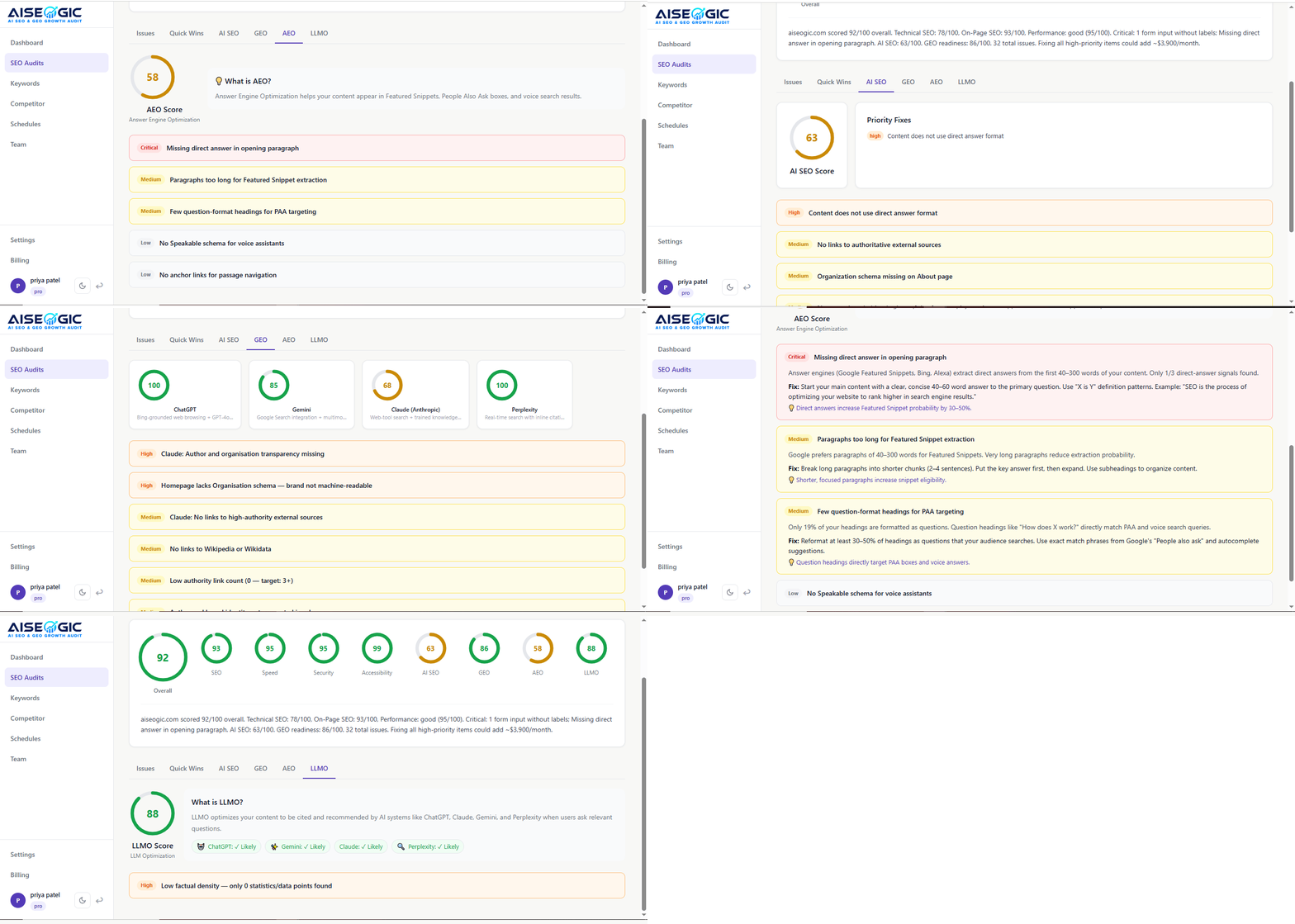
What is wrong?
Identify the exact problem.
Why does it matter?
Explain how the problem can affect SEO, usability, indexing, or AI search visibility.
What should I fix?
Provide a specific recommendation.
How important is it?
Give the issue a priority.
How can I verify the fix?
Provide a simple validation method.
For example:
Issue: Missing canonical tag
Impact: Search engines may have difficulty determining the preferred URL.
Priority: High
Recommended Fix: Add the correct canonical URL to the page.
Verify: Re-crawl the page and confirm the canonical URL.
This is the type of actionable approach AISEOgic should emphasize because homepage already positions the product around prioritized issues, explanations, step-by-step fixes, AI recommendations, and progress tracking.
19. AI SEO Audit Scorecard
A complete audit can be divided into these categories:
| Audit Category | What to Check |
|---|---|
| Technical SEO | Crawlability, indexability, redirects, URLs |
| On-Page SEO | Titles, descriptions, headings, content |
| Content | Quality, relevance, search intent |
| Internal Linking | Site architecture and internal links |
| Schema | Structured data |
| Performance | Core Web Vitals and speed |
| Mobile SEO | Mobile usability |
| Accessibility | Accessibility and usability |
| GEO | Generative search readiness |
| AEO | Answer-engine readiness |
| LLMO | AI understanding |
| Entities | Brand and entity signals |
| Local SEO | Local visibility |
| AI Visibility | AI mentions and citations |
20. Quick AI SEO Audit Checklist
Don’t have time to complete the full audit?
Start with these checks:
- Website uses HTTPS
- Important pages are indexable
- Robots.txt is configured correctly
- XML sitemap exists
- Canonical URLs are correct
- No important broken links exist
- Important pages have unique title tags
- Important pages have useful meta descriptions
- Heading structure is logical
- Content matches search intent
- Important pages have internal links
- Structured data is valid
- Core Web Vitals are reviewed
- Website works well on mobile
- Images are optimized
- Important content is accessible
- Brand information is consistent
- Organization information is clear
- Content answers important questions directly
- Website is structured for AI understanding
- GEO opportunities are reviewed
- AEO opportunities are reviewed
- LLMO opportunities are reviewed
- AI search readiness has been reviewed
Why Use AISEOgic for an AI SEO Audit?
A manual checklist is useful for understanding SEO, but checking every technical and AI-search factor manually can take hours.
AISEOgic brings traditional SEO auditing and AI-search optimization together in one platform.
You can use AISEOgic to identify:
- Technical SEO issues
- On-page SEO problems
- Performance issues
- Schema problems
- Content opportunities
- Internal-link opportunities
- GEO readiness
- AEO readiness
- LLMO readiness
- AI-search opportunities
- Competitor insights
- Prioritized SEO fixes
AISEOgic’s homepage specifically highlights technical SEO auditing, Core Web Vitals, schema, content optimization, competitor analysis, actionable roadmaps, GEO, AEO, LLMO, and AI-search readiness.
Instead of manually checking every item, start with an automated audit and use this checklist to understand the results.
Frequently Asked Questions
What is an AI SEO audit?
An AI SEO audit analyzes your website’s technical SEO, content, structure, performance, and readiness for AI-powered search experiences. It combines traditional SEO checks with areas such as GEO, AEO, and LLMO.
What does an AI SEO audit check?
A complete AI SEO audit can check technical SEO, crawlability, indexability, metadata, content, internal links, structured data, Core Web Vitals, mobile usability, accessibility, entities, GEO, AEO, LLMO, and AI-search visibility.
Is AI SEO different from traditional SEO?
AI SEO expands traditional SEO rather than replacing it. Your website still needs to be crawlable, indexable, useful, fast, accessible, and technically sound. AI SEO additionally focuses on how clearly your content and entities can be understood by AI-powered search systems.
How do I optimize my website for AI search?
Start with strong technical SEO, clear content structure, direct answers, accurate structured data, consistent brand information, useful original content, and clear evidence of expertise. Then monitor your visibility across AI-powered search experiences.
Can SEO guarantee that my website appears in ChatGPT?
No. No legitimate SEO tool or agency can guarantee that an AI system will mention or recommend a particular website. SEO and AI-search optimization can improve discoverability and the quality of information available to search systems, but AI-generated results are not guaranteed.
How often should I perform an AI SEO audit?
Run an audit when launching a website, redesigning a website, making major technical changes, publishing significant content, or periodically as part of your SEO process.
Run Your Free AI SEO Audit
Your website may have SEO and AI-search issues that are difficult to find manually.
AISEOgic can analyze your website and provide actionable recommendations across technical SEO, performance, content, GEO, AEO, LLMO, and AI-search readiness.
Sign up for free, log in to your account, enter your website URL, and start your free audit.
No credit card required.